St. Verena Chapel
The St. Verena Chapel in Rotwand is one of the most impressive places of power on the Renon. High above the Eisack Valley, it sits enthroned on a porphyry hill that was already settled in prehistoric times and probably served as a place of worship. Cup stones have been discovered around the chapel, the significance of which remains a mystery to this day. They may have had ritual functions or served as landmarks, calendars, or even star charts. Near the historic Penzlhof farmstead, on the old Ritten Kaiserstraße road, a 5,000-year-old menhir figure was also found, which is now on display in the Bolzano City Museum.
The little church itself was first mentioned in 1246. Its massive Romanesque tower dates from the 14th century, while the Baroque elements inside—the high altar, the colorful paintings, and the ornate pulpit—are from a later period. Although the church is closed, a small window offers a glimpse into the atmospheric interior. The location and tranquility surrounding the church make the hill a place where you can find inner peace and recharge your batteries.
St. Andrew's Church in Antlas
St. Andrew's Church rises above the historic 12th-century Zunerhof farmstead – another extraordinary place of power with impressive views. Archaeological finds from the Neolithic and Bronze Ages indicate that this hill was also used as a place of worship long before Christianization. The present-day church dates from the 14th century, but experts assume that there was a much older predecessor building due to the apostle's patronage.
Inside, visitors can admire impressive 15th-century frescoes, which lend this small sacred building a special expressiveness. Also worth seeing are the so-called “Neidköpfe” (envy heads), small painted keystones that were supposed to keep evil spirits away, and the sacristy door decorated with St. Andrew's cross. Above it is a representation of Veronica's veil, an icon that was once associated with indulgences. The altarpiece is a copy; the original was painted by Franz Sebald Unterberger, a member of the famous Fleimstal dynasty of painters. Its location on the hill, the tranquility, and the history give this place a unique atmosphere. A visit to the little church is also recommended—the Zunerwirt keeps the key.
Mitterstieler Lake
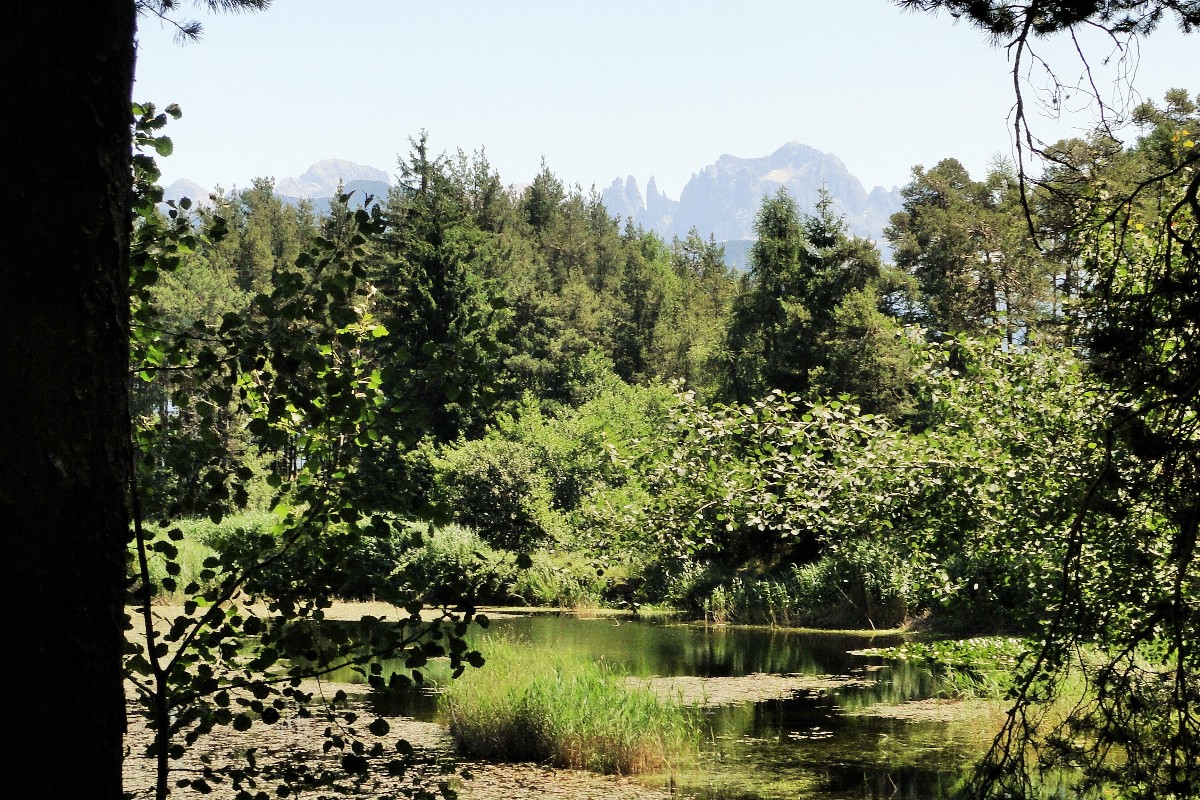
Mitterstieler Lake is a tranquil, almost mystical place of power in the middle of the forest. As a protected biotope, it impresses with its dark water, dense vegetation, and a special diversity of plants, insects, and amphibians. The silence, broken only by animal sounds, gives the place an almost otherworldly atmosphere. The lake invites you to linger, sharpen your senses, and absorb the power of the place.
Ritten Earth Pyramids
The earth pyramids on the Ritten are among the most fascinating natural phenomena in South Tyrol and are also considered one of the region's special places of power. They were formed from glacial moraine clay that was washed out by rain. Large capstones protect the clay underneath, allowing the striking shapes to remain intact for a long time. However, if a pyramid loses its capstone, it is exposed to the rain and gradually disintegrates – an impressive example of the changeability of nature.
On the Ritten, the earth pyramids can be admired in three locations: in the Finsterbach Valley between Lengmoos and Maria Saal, in the Katzenbach Valley below Oberbozen, and in the Gastererbach Valley near Unterinn.
The St. Verena Chapel in Rotwand is one of the most impressive places of power on the Renon. High above the Eisack Valley, it sits enthroned on a porphyry hill that was already settled in prehistoric times and probably served as a place of worship. Cup stones have been discovered around the chapel, the significance of which remains a mystery to this day. They may have had ritual functions or served as landmarks, calendars, or even star charts. Near the historic Penzlhof farmstead, on the old Ritten Kaiserstraße road, a 5,000-year-old menhir figure was also found, which is now on display in the Bolzano City Museum.
The little church itself was first mentioned in 1246. Its massive Romanesque tower dates from the 14th century, while the Baroque elements inside—the high altar, the colorful paintings, and the ornate pulpit—are from a later period. Although the church is closed, a small window offers a glimpse into the atmospheric interior. The location and tranquility surrounding the church make the hill a place where you can find inner peace and recharge your batteries.
St. Andrew's Church in Antlas
St. Andrew's Church rises above the historic 12th-century Zunerhof farmstead – another extraordinary place of power with impressive views. Archaeological finds from the Neolithic and Bronze Ages indicate that this hill was also used as a place of worship long before Christianization. The present-day church dates from the 14th century, but experts assume that there was a much older predecessor building due to the apostle's patronage.
Inside, visitors can admire impressive 15th-century frescoes, which lend this small sacred building a special expressiveness. Also worth seeing are the so-called “Neidköpfe” (envy heads), small painted keystones that were supposed to keep evil spirits away, and the sacristy door decorated with St. Andrew's cross. Above it is a representation of Veronica's veil, an icon that was once associated with indulgences. The altarpiece is a copy; the original was painted by Franz Sebald Unterberger, a member of the famous Fleimstal dynasty of painters. Its location on the hill, the tranquility, and the history give this place a unique atmosphere. A visit to the little church is also recommended—the Zunerwirt keeps the key.
Mitterstieler Lake
Mitterstieler Lake is a tranquil, almost mystical place of power in the middle of the forest. As a protected biotope, it impresses with its dark water, dense vegetation, and a special diversity of plants, insects, and amphibians. The silence, broken only by animal sounds, gives the place an almost otherworldly atmosphere. The lake invites you to linger, sharpen your senses, and absorb the power of the place.
Ritten Earth Pyramids
The earth pyramids on the Ritten are among the most fascinating natural phenomena in South Tyrol and are also considered one of the region's special places of power. They were formed from glacial moraine clay that was washed out by rain. Large capstones protect the clay underneath, allowing the striking shapes to remain intact for a long time. However, if a pyramid loses its capstone, it is exposed to the rain and gradually disintegrates – an impressive example of the changeability of nature.
On the Ritten, the earth pyramids can be admired in three locations: in the Finsterbach Valley between Lengmoos and Maria Saal, in the Katzenbach Valley below Oberbozen, and in the Gastererbach Valley near Unterinn.